

We keep asking what the talent of the future looks like—the tools we hand the first decision to are built to identify past talent.
"AI is eliminating me at the application stage." A capable, well-credentialed executive said that to me last month, and she is not the only one. I have heard a version of it from more people in my network this quarter than I can remember hearing before. The rejections arrive fast, if at all, often before a person has read a word.
It is easy to file each story under a single cause. Too old. Wrong name. Wrong postcode. Wrong accent. The Australian Financial Review recently followed a senior professional who sent 62 applications and got back not one interview. Read enough of these accounts and the same pattern shows through all of them. It is worth naming properly, because we are about to make many decisions on top of it.
The future does not look like the past.
We spend real energy and have conversations asking what the talent of the future looks like. The honest answer is that it does not look like past talent. That is the whole point of the question. Yet the ATS tools we increasingly hand the first cut to pull the other way. Whether they match a resume to the words in the job ad, apply the knockout rules a recruiter has set, or rank people with a model built on past hires, they are tuned to find more of what we already have.
To see why, it helps to borrow a frame from the people who study this for a living. In 2022, the United States standards body, NIST, published a standard on bias for artificial intelligence. It sorts bias into three kinds: statistical, systemic, and human. The useful part for anyone who hires is that the same three describe a person's judgment, not only a machine's. Picture an iceberg. The statistical part is the visible tip, the piece we can measure and audit. The systemic and human parts are the far larger mass below the waterline, and they are the parts we rarely look at.
Three kinds of bias, one result
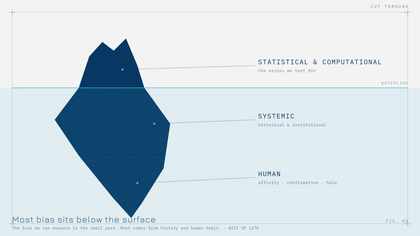
Statistical bias needs no villain. It comes from data that does not represent the people it is used on, and NIST is explicit that it can appear with no prejudice and no intent behind it. Amazon learned this the hard way. Its experimental screening tool, trained on a decade of mostly male resumes, taught itself to mark down applications that mentioned a women's club or an all-women's college. Amazon never put it into service and could not reliably strip out the bias, but the lesson held. Nobody set out to build that. The data did it quietly.
Systemic bias is the historical kind, and it is the one that should hold a TA, Head of HR or Chief People Officer's attention. It enters in two ways, and neither needs a rogue algorithm. A recruiter sets a rigid rule, a keyword, a minimum years figure, a knockout question, and the system screens out anyone who describes the same capability in different words or reached it by a different route. Or a ranking model built on whom the company has hired before learns that pattern and scores the lookalikes higher, usually through proxies like a postcode, a graduation year, or an employment gap rather than any stated rule. Neither widens a workforce. Both are built to match what is already there. In Melbourne in 2024, nine migrant and refugee women from the social enterprise Sisterworks failed AI recruitment interviews because the systems could not read their applications, as the tools could not accommodate varying levels of English literacy and non-native speech. That is systemic bias surfacing as a decision about who belongs.
Human bias is the kind we would rather not examine, because it sits in us. Affinity bias, the quiet pull toward people like us. Confirmation bias, the hunt for evidence that fits a first impression. The halo effect, letting one strong signal colour the whole read. Anchoring on a current salary or a brand-name employer. None of these lives in an algorithm. They live in the interview, and they narrow a shortlist just as efficiently as any model.
Affinity bias in a person and systemic bias in a model are the same failure wearing different clothes. Both reproduce the familiar. So the choice the market keeps selling us, machine screening on one side and human instinct on the other, is a false one. Left unchecked, both run on the past.
This is no longer theoretical.
In the United States, a case against Workday is proceeding on the argument that a vendor whose AI screens candidates can be treated as an agent of the employers that use it, rather than a neutral supplier.
The European Union's AI Act treats recruitment and resume screening as high risk. New York City now requires an annual independent bias audit of hiring tools, with the results published.
Closer to home, the change is concrete and dated. From 10 December 2026, amendments to the Privacy Act require Australian organisations to state in their privacy policy when they use automated decisions that could significantly affect a person, and a decision to interview or reject a candidate falls squarely within scope. Who or what screened your shortlist is becoming a question you must answer in writing.
The interrupt is judgment.
The answer is not to unplug the tools and trust our gut, because the gut runs the third kind of bias. The answer is discipline.
Assess people against criteria you have defined in advance, not against credentials or keywords.
Ask for the specific decisions someone made when the answer was not obvious, not the roles they have held.
Keep a named human, ideally more, accountable for every VC or meeting. Debate against the forward on what they can do
The Australian Public Service already holds itself to a version of this: merit, fairness, transparency, human accountability, and no delegation of the decision to a machine. That is a public standard any board can adopt tomorrow, without a single line of code.
None of this is a compliance chore. It is how you get range. A workforce built for a harder, less predictable decade cannot be chosen by a model trained on the last one, nor by an instinct calibrated on the same history. Confronting bias, in the tool and in ourselves, is the work that makes a different future possible.
So here is the question to ask yourself. Not whether your process uses AI. That one is easy.
Can you explain how your last shortlist was actually made, and which of the three biases it quietly reproduced? If the honest answer is that you cannot, that is where the work begins.
#futureofwork #assessment #recruitment #AI #HR #talentacquisition